Monday, December 7, 2009

Things I’ve Learned About Victorian Literature and Times: My Reflection Paper

Cyndi Hutchinson
English 455, Section 01, Fall 2009
Professor Charles Baraw
Reflection Paper
08 December 2009

Things I've Learned About Victorian Literature and Times

This semester we have read works by male and female authors living during the Victorian period. One theme that I found throughout most of them is the concept of challenging gender roles. Both Charlotte Brontë and Charles Dickens created female characters that tried to live outside of restriction. Jane Eyre wanted to make her own living, and Louisa is determined to be happy even if it means using her heart and not her mind. These two female characters in particular helped to change my view of Victorian culture. When I came into this class I thought that the Victorian period was comprised of stuffy people writing over exaggerated literature. But that has changed.
I now realize that it was not just a time filled with high collars and unexposed ankles. I now know that there was a group of people, many of them writers trying to change the social conventions of the time. It doesn't seem like Charlotte Brontë and Christina Rossetti are radically feminist to the modern reader, but for their time they were blazing a new path. I think that this is the biggest shift I have had in regards to my ideas of Victorian literature. I was afraid that what I was going to read was going to be boring, that the topics would be out of my sphere of understanding. I assumed it would be about the aristocracy and the plights of the dejected working class but I am surprised by how many topics actually concern me.
Another opinion of mine that has changed since the first day of this class is their concern for art. I think, rather naïvely, that I thought there was a lack of appreciation for art during this time. Having been to the Yale Center for British Art I saw the myriad of paintings of men with hunting dogs, and ocean panoramic and while they were beautiful I was somewhat putt-off. I understand that not all of these were from the Victorian period but some were. I think this may have given me a skewed view of Victorian art, namely that it is prudish and kind of uptight. But after reading all of the text this semester including The Fleshly School of Poetry by Robert Buchanan (which is not entirely for sexuality in writing) and Goblin Market by Christina Rossetti I realize that there was a type of sexual awakening at the time. The poetry in particular is full of sensual language and innuendo. This surprised me first, but pleasantly so. I was intrigued by the fact that even women were willing to venture into the realm of sex, because I did not think it was a subject they would be willing to broach.
The text that I found the most engaging was Jane Eyre. Even though I did not agree with her choice of actions, especially since Rochester is potentially one of the biggest jerks I have ever read about, I thought the novel was compelling. I really approved of the fact that Jane Eyre was a strong enough female character that she could set out on her own and try to make her own way. At first I thought she was a radical female character, she was rebellious and outspoken. But in the end I was saddened by the fact that she seemed to conform to societies conventions by marrying Rochester. I think it was partly because Brontë knew that her novel would never be widely accepted if she had a strong female character succeeding entirely on her own.
Overall, I have come to realize that Victorian culture and literature were far more interesting than I thought they would be. They are not boorish and prudish as I assumed they would be, and they had specific ideas about art that conform in some ways to my own. I have found a lot of the topics that were written about intriguing, and I like to see the ways that they align with the way we write about the same topics today. I feel like my appreciation for the Victorian era has grown, and I look forward to reading and learning more.

Monday, November 30, 2009

Please post Fun Dracula stuff!

Here is the list of logical breaks in the reading over the next week:


For Tuesday (tomorrow) p, 160, end of Chapter 13 in which a big plot event transpires.


Thurs 12/3 p. 228 end of Chapter 19.


Tues 12/5 to the end, p. 327.

Thursday, November 5, 2009

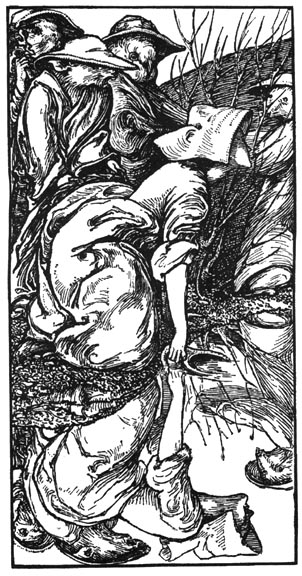
http://www.victorianweb.org/art/illustration/housman/1.jpg

http://www.victorianweb.org/art/illustration/housman/1.jpg

Family Time

Within the first ten lines of reading aloud "Goblin Market," Elijah interrupted the long list of succulent fruits--"Is it a trick? If they eat the fruit, someone will eat them..."  Yes, we were proud parents! He was riveted during most of the story, except a bit at the end, which, when all get happily married, blah, blah, blah is pretty boring! But, that, of course, is the point.

Please post questions on Gabriel Rossetti and perhaps Hopkins too. 

Wednesday, November 4, 2009

Food for Thought on "The Goblin Market"

Note 32, Chapter 4 of the author's Christina Rossetti in Context which the University of North Carolina Press published in 1988. It appears in the Victorian web with the kind permission of the author, who of course retains copyright.
Two radically different perspectives on the poem are articulated by Jerome McGann and Sandra Gilbert. McGann reads the poem as a "prophetic" critique of Victorian marriage markets. For him, the poem is designed to convey ,the need for an alternative social order" (NER, 254). For Gilbert, the goblin mens fruits represent the "fruit of art" whose serious pursuit was forbidden to Victorian women (Madwoman in the Attic, 569-71). The most forceful feminist reading of Goblin Market appears in Homans's essay. She argues that Goblin Market "is about Poetic language as well as about female sexuality" and that Rossetti subverts patriarchal and androcentric traditions of romantic lyric in her poem by showing Lizzie "turning [the goblin men's] assault against their intentions, reappropriating their objectification of her body and transforming that Objectification into her own positive strategy. Having been reduced to mere body within a metaphoric [androcentric] economy by the goblins' assault, Lizzie, by understanding herself as inhabiting instead a metonymic economy ... experiences that body as a source of Power!' According to Homans's reading, Goblin Market demonstrates that "the cure of female sexuality subjected to romantic desire is the cure of metaphor into metonymy" ("'Syllables of Velvet,", 589),

Tuesday, November 3, 2009

Elizabeth Barrett Browning

What was the inspiration for Elizabeth Barrett Browning's empathedic poetry about the slave mother and her fair skined child? What message was she trying to send?

Monday, November 2, 2009

Okay, I WILL cry if not one of you posts here.  And in class too.  It will be ugly.

Friday, October 30, 2009

Eliabeth Barrett Browning: An Overview

There is an incredible amount of material on EBBrowning and "Aurora Leigh," including annotated audio version [next post].  This link takes you to the Victorian Web site for A.L.  I suggest reading the plot summaries for the rest of the book prior to reading the selections in our text.

Also, if you haven't done a group project yet, please contact me.  In addition to discussions of our assigned texts, available topics include discussion of the Rossettis and the Pre-Raphaelite movement.  Please contact me if you need to get a report done! cb

Eliabeth Barrett Browning: An Overview 

AuroraLeigh

AuroraLeigh

Robert Browning's Andrea Del Sarto as Double Self-Portrait

Robert Browning's Andrea Del Sarto as Double Self-Portrait

Charlotte's 'Jane Eyre', Elizabeth's 'Aurora Leigh'

Charlotte's 'Jane Eyre', Elizabeth's 'Aurora Leigh'

Wednesday, October 28, 2009

Lucrezia-Thanks to Jill

Link to Lucrezia's Portrait


Treasure Hunt: find & post the drawing of del Sarto's wife! Extra Credit!!!

Found on the "Victorian Web":  Robert Browning's "Andrea del Sarto" (1855): Making Do with Less
Philip V. Allingham, Contributing Editor, Victorian Editor; Faculty of
Education, Lakehead University (Ontario)

 
 "After the publication of this poem, it became the fashion for every
English lady holidaying in Florence to purchase a copy of Andrea Del
Sarto's cartoon-drawing of his wife, a sketch which would reveal a
power nearly equal to that of Michelangelo, but somehow softer and
more human, although not nearly so inspired."

Andrea del Sarto, The Sacrifice of Abraham 1527-28 Oil on poplar panel, 213 x 159 cm Gemäldegalerie, Dresden

Head of a Young Man 1520 Sanguine Musée du Louvre, Paris

Andrea del Sarto, after Italian, 1487 - 1530 Beheading of St. John the Baptist and presentation of his head, circa 1600 ink and wash


31.2 x 39.9 cm (sheet)
San Francisco Museum of Modern Art, long term loan to the Fine Arts Museums of San Francisco DL1.1976

Tuesday, October 20, 2009

Let's Blog

Please post your reading discussion questions here henceforth.  And check out the video of Tennyson reading...! Fell free to post anything related to our class well.

Search This Blog